

Modern organisations increasingly recognize that strong performance is driven not only by skills and experience but by competence—the behavioural patterns underlying how people think, interact and solve problems. Personality traits and cognitive abilities shape these behaviours, making psychological assessment a powerful tool for evidence-based HR.
What Competence Really Is
Competence can be understood through the KSAO model — Knowledge, Skills, Abilities, and Other Characteristics.
In most professional roles, it is already assumed that employees or candidates possess the essential knowledge and technical skills needed to perform the job. Degrees, certifications, professional experience, and training ensure a baseline of hard skills. Because these components are relatively easy to verify, competence assessment focuses on what differentiates good performance from exceptional performance — the psychological attributes that shape how people apply their skills in real situations.
This is where Tripod tests provide unique value. They target the parts of performance that are hardest to observe yet most predictive: “Abilities” can be measured by Tripod Analytical and “Other characteristics” (personality) by Tripod Persona.
These deeper factors explain why people behave the way they do, how they respond to challenges, and how they fit into teams, adapt to change, collaborate, communicate, and solve problems. While hard skills may qualify someone for a role, traits and abilities often determine how successfully and sustainably they perform within a real organisational context.
How Organisations Use Tripod Tests in Practice for a competence assessment
To illustrate how competence assessment works in real organisations, consider a recent large-scale project involving a group of frontline operational professionals working across multiple locations. The main challenges of the role: high customer contact, pressure to solve problems independently, and the need to stay organised in unpredictable environments.
1. Assessing Current Competence Levels
The organisation wanted to understand which competence areas were strengths and which required development. All employees completed Tripod Persona online and Tripod Analytical in supervised conditions. The results were combined with the organisation’s competence model, focusing on customer orientation, communication, problem-solving, stress resilience, initiative and adaptability.
2. Identifying High-Potential Talent and Risk Areas
The combined results allowed the organisation to identify individuals with clear leadership potential as well as those who needed support in areas like planning, communication or stress management. Rather than relying on assumptions or one-off observations, decisions were based on evidence from both traits and abilities.
3. Designing Targeted Development Activities
Based on the assessment, the organisation launched a development programme.
Modules included:
- Effective communication and conflict handling
- Stress resilience and emotional regulation
- Structured problem-solving
- Planning and organisation
Tripod results were used to tailor coaching conversations, ensuring each employee received development feedback aligned with their personality profile and reasoning strengths.
4. Supporting Managers With Evidence-Based Insights
Managers received aggregated team-level insights, helping them understand:
- why certain collaboration challenges occurred,
- which employees needed more structure or guidance,
- how to assign tasks based on strengths,
- and how to adapt feedback approaches to each team member.
This increased consistency in day-to-day management and improved overall team effectiveness.
Conclusion
Competence is behaviour — and behaviour has psychological roots. This organisational example demonstrates how Tripod tests offer a scientifically grounded, practical way to understand the traits and abilities that shape performance. When integrated into competence models, Tripod results help organisations make clearer decisions, build targeted development plans, and create stronger, more adaptable teams.
With evidence-based insights, organisations can move beyond intuition and towards a more transparent, fair and effective way of evaluating and developing talent.
Similar news
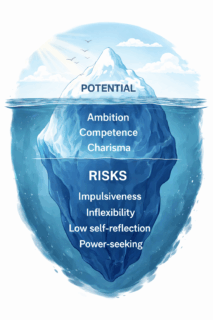
When High Potential Becomes High Risk: Identifying Derailers Early
Hiring a new team member with stellar credentials and apparent high potential is every manager’s dream. But what happens when that high potential quietly turns into high risk? In HR and organizational psychology, derailers describe personality traits or behavioral patterns that can derail one’s career in the wrong direction due to overlooked or overused traits that are overshadowed by high potential; these often surface only after hiring […]

Self-Presentation for Different Interview Types
In today’s recruitment landscape, candidates often move through several interview formats before receiving an offer. Each format – phone, video or on-site – requires a different approach to communication, environment, and energy. While your skills stay the same, the way you present them must shift to match the setting. Understanding these nuances not only helps […]

What You Need to Know When Planning a Career in IT
In recent years, the pace of IT recruitment has slowed down. The sector has grown, but at a slower rate than before 2023, and the demand for specific specializations has shifted significantly. While there is no shortage of CVs on the job market, companies are increasingly facing not a lack of candidates, but a very […]

Pulse Survey or Organizational Survey – Which One to Choose?
In recent years, more and more companies have shown interest in employee pulse surveys – short, regular surveys designed to understand employees’ everyday experiences and attitudes. These surveys have become trendy and seemingly easy to implement. But behind this speed and convenience lies a critical question: Do pulse surveys really deliver what we expect from them? […]

Why Do We Sometimes Fail to See the Obvious? Confirmation Bias in HR Practice
Since I began working in consulting, I’ve repeatedly encountered a recurring pattern. When meeting with potential clients, I often hear things like: “I’ve been working in HR for over 10 or 20 years – I know what I’m doing. What exactly could you offer me?” Or: “I’ve taken hundreds of different tests – what could […]

From AI Adoption to AI Adaptation: The Skill Employers Are Already Hiring For in 2025
Two years ago, adding “proficient in ChatGPT” to your CV made you look innovative. Today, it’s the new “Microsoft Word.” Everyone’s using AI — what matters now is how you’re using it. In 2025, the conversation has shifted from AI adoption to AI adaptation. This isn’t about learning the tools — it’s about changing how […]
Why Hiring Salespeople Is Hard — And How We Help Companies Get It Right
At Tripod Link, we specialize in hiring top-performing salespeople — from Business Development Managers to Account Executives — because we know how hard sales recruitment really is. Whether it’s a Business Development Manager, Account Executive, or Sales Manager, the message is the same: “We need someone who can drive results — and fast.” We get […]

Decline in leaving considerations – possible causes and impact on the labor market
Tripod has been surveying employees of Estonian and international organizations for almost 30 years and has always investigated their intention to change jobs, i.e. to leave their current employer. In 2023, we saw the highest rate of intention to leave in the history of Tripod’s surveys, which was 35%. In contrast, when we summarized the […]